•
How Mature is Your Data and Analytics Strategy? A Guide to Evolving Your Approach
Does your business struggle to turn raw data into actionable insights? You’re not alone. In a survey by Microsoft Canada, 61% of business decision-makers agreed that data is key to business success, yet only 34% have implemented a comprehensive data strategy framework.
Why the gap? Many companies lack the knowledge or resources to evolve their data and analytics approach. In this guide, we’ll break down how to build a modern data and analytics strategy, step by step. You’ll discover:
- What is data?
- What is analytics?
- What is a data and analytics strategy?
- Why do you need a data strategy framework?
- How to create a data and analytics strategy
- Getting started with informed decision making
What is Data?
Data refers to the facts, figures, and information your business collects. While often numeric, business data can also include details about people, objects, or transactions, depending on what your business focus is. Whether it’s customer purchase history, website traffic metrics, or inventory levels, data serves as the foundation for meaningful, analytical insights and informed decision making.
What is Analytics?
Analytics is the process of examining data to identify meaningful patterns and trends within your business. By leveraging technology, analytics transforms raw data into visual reports and actionable insights for decision-makers. With the right data structure and tools, analytics can deliver real-time insights to help teams act quicker, make informed decisions, drive growth, enhance client experiences, and stay competitive.
As Microsoft Canada’s President, Kevin Peesker, said “Data has become the most valuable currency for organizations in a digital, cloud-first world. Regardless of the size or type of organization, leveraging AI, data and analytics is crucial.”
What is a Data and Analytics Strategy?
A data and analytics strategy is the blueprint for how your business organizes, stores, and structures its data to extract valuable insights. When properly implemented, this strategy transforms raw data into actionable intelligence, allowing you to report on things in real-time through custom dashboards and visual tools. With this foundation, your teams gain visibility into business performance and can make informed , data-driven decisions.
While analyzing data isn’t a new concept, what’s different today is how advanced the tools have become. With platforms powered by AI and machine learning, you can now structure and model your data in ways that make uncovering critical business insights faster and easier than ever.
Here’s a pro tip: your data and analytics strategy shouldn’t exist in isolation. It needs to align with your company’s overall goals. By tying Key Performance Indicators (KPIs) directly to your corporate strategy, you ensure your data is working in sync with your bigger vision. That alignment is what keeps your organization focused and moving in the right direction.
Why You Need a Data Strategy Framework
A strong data strategy framework isn’t just a nice-to-have—it’s essential if you want your business to stay competitive. Without a clear structure, data can feel overwhelming—just a mass of numbers and facts without direction. But with the right framework, that same data becomes one of your most valuable assets. Here’s why investing in a data strategy framework is worth it:
1) Turn Data into Insights
Raw data on its own doesn’t add much value—it’s what you do with it that counts. A framework organizes your data, making it easier to uncover trends, patterns, and insights that can inform your decisions and drive progress.
2) Respond Quickly to Change
Today, agility is key. A framework gives you real-time access to the information you need, so you can quickly adapt to market shifts, address challenges, and seize opportunities as they arise.
3) Align Your Teams
Disjointed data leads to confusion and inefficiency. A well-structured framework ensures that all teams are working with the same reliable information, improving collaboration and ensuring decisions are based on a single source of truth.
4) Advanced Analytics Capabilities
A good framework sets the stage for advanced analytics tools like machine learning and predictive modeling. With these capabilities, you can move beyond understanding “what happened” to forecasting “what’s next” and even automating decisions.
5) Data Security and Compliance
Managing data comes with responsibilities. A solid framework ensures your data is accurate, secure, and compliant with regulations, reducing risks and building trust with stakeholders.
6) Support Long-Term Growth
A data strategy framework isn’t just about solving today’s problems—it’s about positioning your business for sustained success. With a scalable framework in place, your organization can continue to evolve and grow, powered by smarter, data-driven decisions.
The Levels to Data and Analytics Strategy
How sophisticated are your analytics insights? Let’s take a look at the four levels of data maturity.
Building a Strong Foundation with Data
There is no magic wand for creating a great data strategy—it starts with building a solid plan and prioritizing data and analytics as a foundation. From this groundwork, your strategy can grow into a comprehensive data framework.
A strong framework includes three critical components:
- Data inputs: Sources like apps and systems that feed data into your organization.
- Storage solutions: Tools such as data warehouses or data lakes that store your information securely.
- Analysis and reporting: Dashboards, visual reports, and predictive analytics that turn raw data into actional insights.
With these foundational pieces in place, you can begin to integrate valuable business intelligence tools, implement advanced analytics, and eventually reach decision automation and support. Here’s a breakdown of the four stages of maturity when it comes to informed decision making driven by analytical insights.
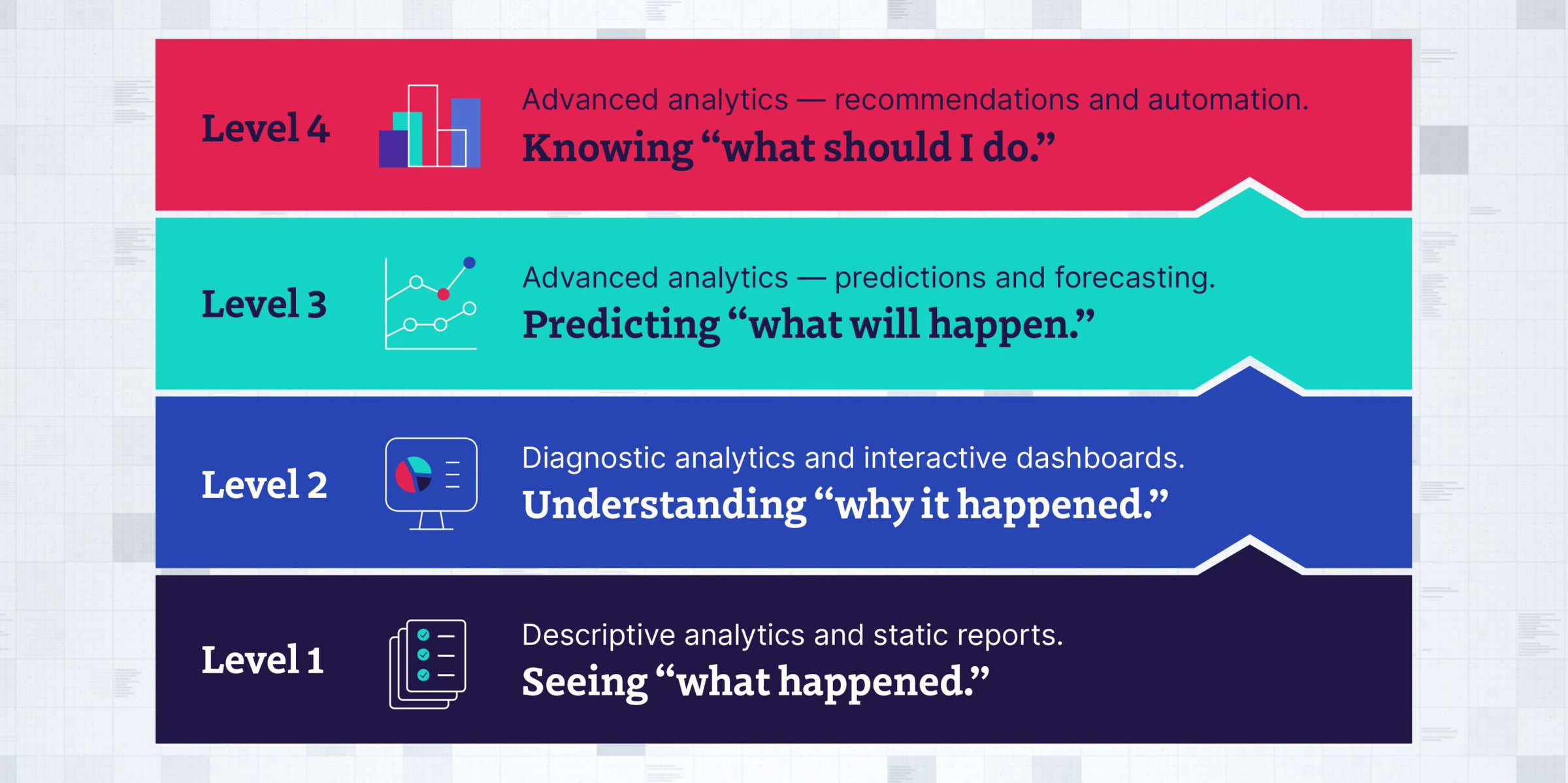
Level 1 – Descriptive Analytics and Static Reports
This is where most businesses start: descriptive analytics using static reports. At this stage:
- Tools: Spreadsheets are the primary tool of choice for tracking, inputting, and reporting data.
- Challenges: Developing reports requires significant manual effort and time, from preparation to validation.
- Analysis: Once reports are published, the task of analyzing the data typically falls on a small group of people who are most familiar with the numbers to draw conclusions and make recommendations.
While this approach provides insights into “what happened,” it’s time-consuming and limits the scope of your analysis to just a few individuals.
Level 2 – Diagnostic Analytics and Interactive Dashboards
At this level, businesses move beyond static reports to more dynamic and diagnostic tools like interactive dashboards. Key features include:
- Decentralized access: Decision-making expands to more team members as dashboards make data easier to access and understand.
- Tools: Analytics platforms, like Power BI, display real-time data in a visual, interactive format.
- Speed and Agility: Teams can respond more quickly to changes in the business, as insights are delivered faster and with greater clarity.
Level 3 – Advanced Analytics – Predictions and Forecasting
Here, your business will unlock the power of predictive analytics. This stage introduces advanced tools like machine learning and artificial intelligence to:
- Forecast trends and future events
- Predict consumer behaviours with greater accuracy
- Enable smarter, faster decision-making with less manual effort
By using these technologies, your organization can move from understanding past performance to anticipating future outcomes—a significant competitive advantage.
Level 4 – Advanced Analytics – Recommendations and Automation
At the highest level, analytics become a driver of automation and decision-making support. Here, you’ll benefit from:
- Automated actions: Your systems can automatically trigger actions based on analyzed data. For example, bots might monitor your inventory levels and automatically reorder stock when it’s running low.
- Efficient processes: Automation will reduce manual workloads, allowing your teams to focus on higher-value tasks.
- Decision support: Data-powered recommendations will begin guiding your strategic decisions, improving accuracy and efficiency.
This level represents the pinnacle of a modern data strategy.
Data is everywhere, but turning it into something actionable can feel like a challenge. That’s where a solid data and analytics strategy comes in—it’s the key to transforming raw information into decisions that drive real results and improve how your business operates. To get there, you need tools and processes that make it easy to analyze large amounts of data efficiently.
When you build this capability, you’ll move through the stages of analytics maturity:
- Level 1: Seeing “what happened.”
- Level 2: Understanding “why it happened.”
- Level 3: Predicting “what will happen.”
- Level 4: Knowing “what should I do.”
At the highest level, your business becomes truly intelligent—able to create value, manage risk, and make smarter, faster decisions that keep you ahead of the curve.
Getting Started with Data-Informed Decision Making
A well-executed data and analytics strategy can be transformative for your business, unlocking opportunities for smarter decisions and sustained growth. Yet, many companies struggle with where to begin or lack the in-house expertise to build and execute a comprehensive strategy.
That’s where Convverge comes in. As a Microsoft Gold Partner, our team of certified business analytics experts specializes in helping organizations harness the power of tools like Power BI to turn raw data into actionable insights. Whether you’re looking to refine your existing approach or start from scratch, we’re here to provide the expertise and support you need.
Our goal is simple: to strengthen your team with the knowledge and tools to uncover new opportunities and realize the full potential of your data.
Let’s get started. Contact us today to take the first step in building a data-driven future for your business.