
ERP Implementation: How to Avoid Costly Mistakes That Derail Projects
Written By: David Borys, Dynamics 365 Functional Consultant
ERP implementation projects are often complex, high-impact initiatives that touch nearly every part of an organization. When they go off track, it’s rarely because of the software itself. More often, challenges stem from planning gaps, unclear ownership, misaligned expectations, and underestimating the level of operational change involved.
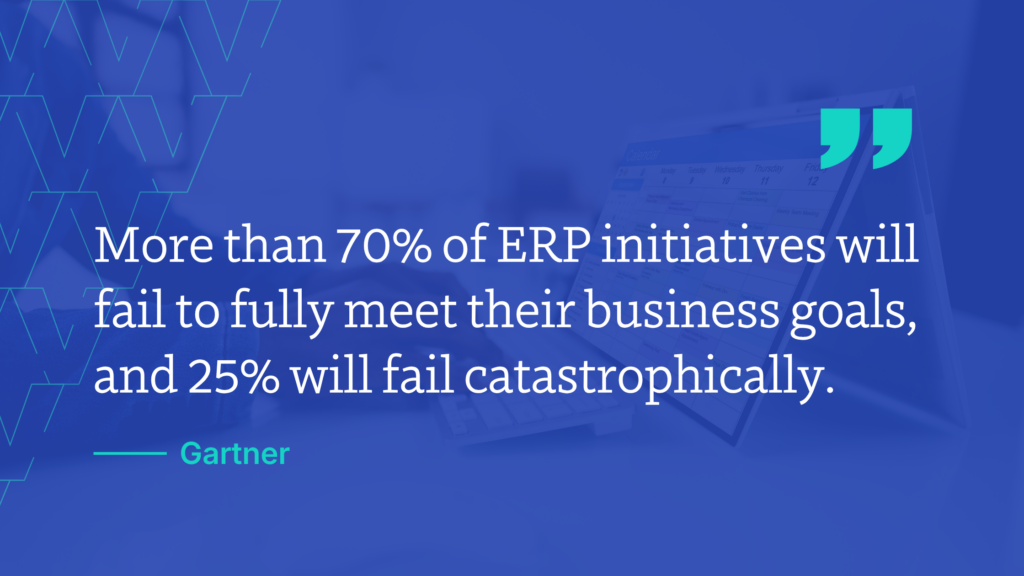
That’s why more than 70% of ERP initiatives will fail to fully meet their business goals—and 25% will fail catastrophically, according to Gartner. With that shocking statistic in mind, the obvious question becomes: how do we avoid an ERP implementation disaster?
Many organizations approach ERP implementation as a technology deployment. In reality, it’s a business transformation. The system becomes the backbone for finance, operations, reporting, and decision-making, which means success depends just as much on process design, data readiness, and change management as it does on the platform.
In this article, we’ll explore:
- The most common ERP implementation mistakes organizations encounter
- How to avoid ERP implementation errors with a strategic approach
- Choosing the right ERP system for your organization
- What to look for in an ERP implementation partner
The Most Common ERP Implementation Challenges
Most ERP implementation challenges don’t start with technology. They start with how the project is planned, owned, and positioned inside the business. When those foundations aren’t clear, even the best ERP platform will struggle to deliver its full value.
Below are the most common issues organizations encounter and why they tend to show up.
Treating ERP as a software install instead of a business transformation.
One of the most common mistakes organizations make is approaching ERP implementation as a technology deployment. The focus stays on features, configuration, and go-live timelines, while the bigger picture gets overlooked. In fact, a Gartner survey revealed that 75% of ERP strategies aren’t aligned to the overall business strategy.
As the saying goes: fail to plan, then plan to fail.
In reality, an ERP system becomes the operational backbone of the business. It shapes how finance closes the books, how inventory is managed, how orders flow, and how leaders make decisions. When ERP is treated as an IT project instead of an operating model redesign, organizations often end up with modern software running outdated processes.
Misaligned expectations between finance, operations, and IT.
ERP implementations touch multiple departments, each with their own priorities and definitions of success. Finance may be focused on controls, reporting, and compliance. Operations may want efficiency and flexibility. IT may be thinking about security, integrations, and scalability.
When these expectations aren’t aligned early, the project becomes a series of compromises rather than a unified transformation. Decisions get delayed, scope creeps, and teams lose confidence in the direction of the implementation.
Underestimating data cleanup and migration complexity.
Legacy systems tend to accumulate years of inconsistent, incomplete, and duplicated data. That data doesn’t magically improve just because a new ERP system is being introduced.
ERP system implementation requires careful data governance, validation, and cleanup long before migration begins. When this work is rushed or underestimated, organizations risk bringing old problems into a new platform, undermining reporting accuracy and user trust from day one.
Overlooking change management and user adoption.
Even the most well-designed ERP system won’t deliver value if people don’t use it properly. New workflows, approvals, and reporting structures require a shift in how teams work day to day.
Without a structured change management approach, users may resist the system, revert to spreadsheets, or create workarounds that fragment the process all over again. Training, communication, and leadership support are just as critical to ERP success as system configuration.
How to Avoid Costly ERP Implementation Mistakes
Avoiding common ERP implementation pitfalls starts with a shift in mindset. The goal isn’t just to replace legacy software. It’s to design a system that reflects how your business operates today and how it needs to operate in the future.
The most successful ERP projects share a few core principles:
Start with clear business ownership.
An ERP implementation needs an executive sponsor who is accountable for outcomes, not just timelines. That sponsor brings together finance, operations, and IT around a shared vision and makes decisions when trade-offs inevitably arise. Without strong leadership, projects lose momentum and direction.
Invest time upfront in process design.
Before any configuration begins, organizations need a clear understanding of how work flows across departments, where bottlenecks exist, and where automation will create the most value. This creates a blueprint for the ERP system rather than forcing the business to adapt to default settings.
Treat data as a strategic asset.
That means establishing data standards, cleaning up legacy records, and validating information before migration ever starts. Clean data ensures accurate reporting, better forecasting, and stronger decision-making once the system is live.
Build change management into the project plan from day one.
Training, communication, and user enablement aren’t afterthoughts. They’re part of the implementation itself. When teams understand why changes are happening and how the new system supports their work, adoption happens faster and with far less friction.
When ERP implementation is approached with this level of discipline and intent, the technology becomes an enabler instead of a constraint, and your organization will be positioned to capture long-term value from the investment.
Exploring ERP Options: Choosing a Platform that Fits Your Organization
Once an organization has a clear understanding of its operating model, processes, and growth objectives, the next step is evaluating which ERP platform is the right fit. This is where many teams feel pressure to move quickly, but choosing the right system requires more than a feature comparison.
Different ERP platforms are built for different stages, structures, and levels of complexity. The best choice is the one that aligns with how your business operates today and how it plans to scale tomorrow.
For many growing and mid-sized organizations, Microsoft Dynamics 365 Business Central is a strong option. It’s designed for businesses that need a modern, integrated ERP platform without the cost, rigidity, or overhead of traditional enterprise systems. It brings finance, operations, supply chain, and reporting together in a single environment, while remaining flexible enough to support evolving business models.
Business Central is particularly well suited for organizations that:
- Have outgrown entry-level accounting software like Quickbooks
- Need better visibility across finance and operations
- Want stronger reporting and forecasting capabilities
- Are scaling and require more structure without adding unnecessary complexity
When implemented with the right ERP strategy, Business Central provides a solid foundation for operational control, performance management, and long-term growth. But like any ERP platform, its success depends on how well it’s aligned to the organization’s processes, data, and governance model.
The goal isn’t to choose the most powerful system on the market. It’s to choose the system that fits your business, and then design it properly.
What to Look For in an ERP Implementation Partner
Choosing the right ERP platform is only part of the equation. The success of an ERP implementation is heavily influenced by the partner guiding the process. The right ERP system implementation partner brings structure, clarity, and strategic thinking to what is often one of the most complex initiatives an organization will undertake.
When evaluating ERP implementation partners, look for a team that can demonstrate the following:
- Business-first mindset: Your partner should focus on understanding your operating model, growth strategy, and organizational priorities before recommending technology. ERP should support the business, not dictate how it runs.
- Cross-functional alignment: A strong partner knows how to bring finance, operations, and IT together around a shared vision and decision-making framework, ensuring the project moves forward with clarity and accountability.
- Process and operating model design: Before any configuration begins, your partner should help define how work flows across the organization and where automation, controls, and visibility will create the most value.
- Data and governance expertise: ERP success depends on data quality and ownership. Your partner should help establish standards, accountability, and validation processes long before migration begins.
- Change management and user adoption: Training, communication, and enablement should be built into the implementation plan, not added at the end. The goal is to ensure teams are confident and productive from day one.
- Ability to extend and customize the platform: No two businesses operate the same way. Your partner should be able to extend your ERP system with custom workflows, integrations, and applications—including solutions like Power Apps—so the platform supports your unique requirements rather than forcing workarounds.
- Long-term partnership approach: ERP is not a one-time project. Your partner should be thinking about scalability, continuous improvement, and how the platform evolves as your business grows.
At Convverge, ERP implementation is approached as a strategic initiative, not a software deployment. Our role as ERP consultants is to help organizations design operating models that support growth, improve visibility, and create long-term value with technology as the enabler, not the driver.

Need Help With Your ERP Implementation?
A successful ERP implementation isn’t defined by the software you choose. It’s defined by how well the system is aligned to your operating model, your data, and your people. When organizations take a business-first approach—with clear ownership, strong process design, and a focus on adoption—ERP becomes a platform for scale rather than a source of friction.
If you’d like to see what this looks like in practice, read our case study on how a Canadian clean-tech manufacturer transformed its financial operations with Dynamics 365 Business Central.
At Convverge, we specialize in Dynamics 365 Business Central implementations, and our ERP consulting practice helps you get the most out of your investment. If you’re ready to start exploring options, book a consultation today.